 Galvanized steel structures operating in special corrosive environments require specialized protection strategies. The galvanized pipes in the chemical industrial zone should be inspected for the amount of organic matter deposited on the surface every quarter. When the thickness of the crystalline salt accumulation exceeds 0.3mm, they must be flushed with a low-pressure water gun (pressure ≤70MPa). The equipment area of the nuclear power plant must undergo gamma-ray scanning every six months to detect the risk of hydrogen embrittlement of the coating caused by hydrogen penetration. The connection parts of the coastal trestles need to undergo coating impedance analysis annually. When the polarization resistance is lower than 10kΩ·cm², epoxy sealing primer containing aluminum powder should be reapplied. The case of the Portsmouth Naval Base in the UK confirms that this plan has extended the maintenance cycle from 12 months to 36 months.
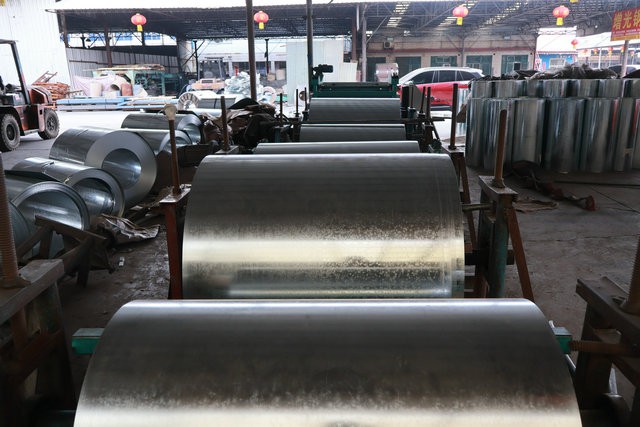
The uniformity of zinc flower crystallization on the surface of galvanized steel sheets directly affects their corrosion resistance. In hot-dip galvanizing operations, the temperature of the zinc bath must be strictly maintained at 450±10℃, and the galvanizing time should be precisely controlled within the range of 100 to 300 seconds. For steel plates with a thickness of 6 to 30mm, the offline eddy current thickness gauge needs to perform a full surface scan with a grid density of 10×10cm to ensure that the deviation of the zinc coating thickness within each square meter does not exceed 15 microns (ISO 1461 stipulates that the local minimum thickness shall not be less than 70% of the average value). After plating, X-ray fluorescence spectrometer should be used for random inspection (10% sample size per batch) to reduce the error range of the salt spray test life to within ±48 hours.
Intelligent monitoring of Galvanized steel plate maintenance work has become an important trend. For instance, the Internet of Things (iot) corrosion monitoring system deployed on CNOOC's Zhuhai platform collects real-time parameters such as temperature (-5℃ to 45℃), humidity (30% to 95%RH), and corrosion current (0.1 to 10μA/cm²) at 200 key nodes, enabling predictive analysis of the rate of coating degradation. This system, in conjunction with quarterly drone aerial photography inspections, has reduced the maintenance cost budget by 27% and compressed the probability of unexpected downtime from an annual rate of 18.7% to 3.2%. The NAS corrosion database confirms that a digital maintenance management strategy can reduce the 25-year full life cycle cost by 350,000 to 400,000 US dollars per thousand tons.
Galvanized steel structures operating in special corrosive environments require specialized protection strategies. The galvanized pipes in the chemical industrial zone should be inspected for the amount of organic matter deposited on the surface every quarter. When the thickness of the crystalline salt accumulation exceeds 0.3mm, they must be flushed with a low-pressure water gun (pressure ≤70MPa). The equipment area of the nuclear power plant must undergo gamma-ray scanning every six months to detect the risk of hydrogen embrittlement of the coating caused by hydrogen penetration. The connection parts of the coastal trestles need to undergo coating impedance analysis annually. When the polarization resistance is lower than 10kΩ·cm², epoxy sealing primer containing aluminum powder should be reapplied. The case of the Portsmouth Naval Base in the UK confirms that this plan has extended the maintenance cycle from 12 months to 36 months.
The uniformity of zinc flower crystallization on the surface of galvanized steel sheets directly affects their corrosion resistance. In hot-dip galvanizing operations, the temperature of the zinc bath must be strictly maintained at 450±10℃, and the galvanizing time should be precisely controlled within the range of 100 to 300 seconds. For steel plates with a thickness of 6 to 30mm, the offline eddy current thickness gauge needs to perform a full surface scan with a grid density of 10×10cm to ensure that the deviation of the zinc coating thickness within each square meter does not exceed 15 microns (ISO 1461 stipulates that the local minimum thickness shall not be less than 70% of the average value). After plating, X-ray fluorescence spectrometer should be used for random inspection (10% sample size per batch) to reduce the error range of the salt spray test life to within ±48 hours.
Intelligent monitoring of Galvanized steel plate maintenance work has become an important trend. For instance, the Internet of Things (iot) corrosion monitoring system deployed on CNOOC's Zhuhai platform collects real-time parameters such as temperature (-5℃ to 45℃), humidity (30% to 95%RH), and corrosion current (0.1 to 10μA/cm²) at 200 key nodes, enabling predictive analysis of the rate of coating degradation. This system, in conjunction with quarterly drone aerial photography inspections, has reduced the maintenance cost budget by 27% and compressed the probability of unexpected downtime from an annual rate of 18.7% to 3.2%. The NAS corrosion database confirms that a digital maintenance management strategy can reduce the 25-year full life cycle cost by 350,000 to 400,000 US dollars per thousand tons.
What maintenance is needed for Galvanized plate products?
Effective maintenance of galvanized steel sheet products is particularly crucial for maintaining their excellent performance and significantly extending their designed service life of 20 to 50 years. The most basic surface cleaning should be carried out with differentiated plans based on the specific deployment environment. In coastal areas with high salt spray (salt concentration ≥0.5mg/m³) or severe industrial pollution (sulfur oxide concentration exceeding 150μg/m³), a higher cleaning frequency should be implemented (recommended 2-3 times per month). Select a neutral cleaner with a pH range of 5 to 12 to avoid chemical damage to the zinc layer with an average thickness of 80μm. Research shows that data from monitoring points of the National Atmospheric Deposition Program in the United States indicates that galvanized structures that are not cleaned regularly suffer a corrosion rate of up to 20μm of zinc layer per year in industrial areas, far exceeding the 5-8μm in inland areas.
When mechanical damage or surface scratches are found, the coating damage shall be classified and treated in accordance with ASTM A123 technical specification. When the area of zinc coating loss is less than 100mm² and the substrate is not exposed, cold-sprayed zinc repair materials with a zinc content of over 96% can be used (the coating amount should be ≥500g/m²). If the exposed area of the substrate exceeds 150mm², hot-dip galvanizing welding repair should be carried out in accordance with ISO 1461 standard. The thickness of the patch should reach 120% of the original design thickness to ensure effective cathodic protection with the original coating. The relative humidity of the environment during operation must be controlled below 85% to ensure adhesion. For critical structures such as Bridges or transmission towers, the anti-corrosion performance after damage repair needs to be verified through a 240-hour neutral salt spray test.
Galvanized steel structures operating in special corrosive environments require specialized protection strategies. The galvanized pipes in the chemical industrial zone should be inspected for the amount of organic matter deposited on the surface every quarter. When the thickness of the crystalline salt accumulation exceeds 0.3mm, they must be flushed with a low-pressure water gun (pressure ≤70MPa). The equipment area of the nuclear power plant must undergo gamma-ray scanning every six months to detect the risk of hydrogen embrittlement of the coating caused by hydrogen penetration. The connection parts of the coastal trestles need to undergo coating impedance analysis annually. When the polarization resistance is lower than 10kΩ·cm², epoxy sealing primer containing aluminum powder should be reapplied. The case of the Portsmouth Naval Base in the UK confirms that this plan has extended the maintenance cycle from 12 months to 36 months.
The uniformity of zinc flower crystallization on the surface of galvanized steel sheets directly affects their corrosion resistance. In hot-dip galvanizing operations, the temperature of the zinc bath must be strictly maintained at 450±10℃, and the galvanizing time should be precisely controlled within the range of 100 to 300 seconds. For steel plates with a thickness of 6 to 30mm, the offline eddy current thickness gauge needs to perform a full surface scan with a grid density of 10×10cm to ensure that the deviation of the zinc coating thickness within each square meter does not exceed 15 microns (ISO 1461 stipulates that the local minimum thickness shall not be less than 70% of the average value). After plating, X-ray fluorescence spectrometer should be used for random inspection (10% sample size per batch) to reduce the error range of the salt spray test life to within ±48 hours.
Intelligent monitoring of Galvanized steel plate maintenance work has become an important trend. For instance, the Internet of Things (iot) corrosion monitoring system deployed on CNOOC's Zhuhai platform collects real-time parameters such as temperature (-5℃ to 45℃), humidity (30% to 95%RH), and corrosion current (0.1 to 10μA/cm²) at 200 key nodes, enabling predictive analysis of the rate of coating degradation. This system, in conjunction with quarterly drone aerial photography inspections, has reduced the maintenance cost budget by 27% and compressed the probability of unexpected downtime from an annual rate of 18.7% to 3.2%. The NAS corrosion database confirms that a digital maintenance management strategy can reduce the 25-year full life cycle cost by 350,000 to 400,000 US dollars per thousand tons.
Galvanized steel structures operating in special corrosive environments require specialized protection strategies. The galvanized pipes in the chemical industrial zone should be inspected for the amount of organic matter deposited on the surface every quarter. When the thickness of the crystalline salt accumulation exceeds 0.3mm, they must be flushed with a low-pressure water gun (pressure ≤70MPa). The equipment area of the nuclear power plant must undergo gamma-ray scanning every six months to detect the risk of hydrogen embrittlement of the coating caused by hydrogen penetration. The connection parts of the coastal trestles need to undergo coating impedance analysis annually. When the polarization resistance is lower than 10kΩ·cm², epoxy sealing primer containing aluminum powder should be reapplied. The case of the Portsmouth Naval Base in the UK confirms that this plan has extended the maintenance cycle from 12 months to 36 months.
The uniformity of zinc flower crystallization on the surface of galvanized steel sheets directly affects their corrosion resistance. In hot-dip galvanizing operations, the temperature of the zinc bath must be strictly maintained at 450±10℃, and the galvanizing time should be precisely controlled within the range of 100 to 300 seconds. For steel plates with a thickness of 6 to 30mm, the offline eddy current thickness gauge needs to perform a full surface scan with a grid density of 10×10cm to ensure that the deviation of the zinc coating thickness within each square meter does not exceed 15 microns (ISO 1461 stipulates that the local minimum thickness shall not be less than 70% of the average value). After plating, X-ray fluorescence spectrometer should be used for random inspection (10% sample size per batch) to reduce the error range of the salt spray test life to within ±48 hours.
Intelligent monitoring of Galvanized steel plate maintenance work has become an important trend. For instance, the Internet of Things (iot) corrosion monitoring system deployed on CNOOC's Zhuhai platform collects real-time parameters such as temperature (-5℃ to 45℃), humidity (30% to 95%RH), and corrosion current (0.1 to 10μA/cm²) at 200 key nodes, enabling predictive analysis of the rate of coating degradation. This system, in conjunction with quarterly drone aerial photography inspections, has reduced the maintenance cost budget by 27% and compressed the probability of unexpected downtime from an annual rate of 18.7% to 3.2%. The NAS corrosion database confirms that a digital maintenance management strategy can reduce the 25-year full life cycle cost by 350,000 to 400,000 US dollars per thousand tons.