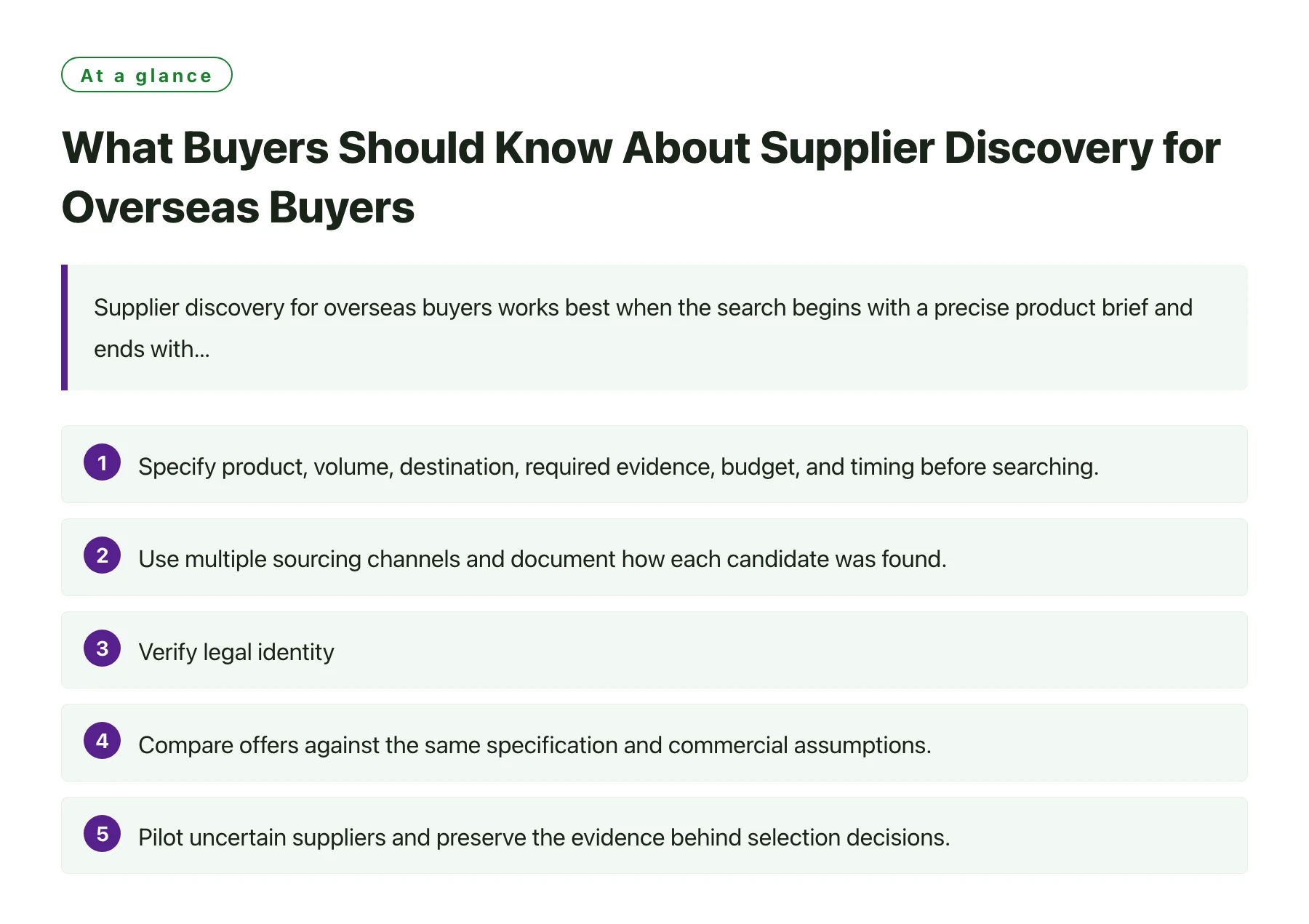
Supplier discovery for overseas buyers works best when the search begins with a precise product brief and ends with evidence that supports a buying decision. Define product requirements, market, volume, timing, and risk; search across suitable channels; then verify identity, manufacturing role, capability, and response quality. A large contact list is not the result. The result is a manageable shortlist whose differences and evidence gaps are visible to the buyer.
Key takeaways
- Specify product, volume, destination, required evidence, budget, and timing before searching.
- Use multiple sourcing channels and document how each candidate was found.
- Verify legal identity, factory role, category fit, capacity, and references where possible.
- Compare offers against the same specification and commercial assumptions.
- Pilot uncertain suppliers and preserve the evidence behind selection decisions.
Keep discovery, qualification, technical approval, and final award as separate decision steps.
1. Write the sourcing brief before contacting suppliers
Describe the product with drawings, materials, dimensions, performance requirements, finish, packaging, annual or initial quantity, destination, and target delivery window. Identify non-negotiable requirements separately from preferences. Include expected testing, certificates, labeling, language, and import responsibilities only after the destination and intended use are known. A complete brief lets candidates respond to the same scope and reveals which details still need engineering input.
Set commercial assumptions for the request: order size, currency, quote validity, delivery basis, payment expectations, tooling, samples, and service needs. Ask suppliers to list exclusions and proposed deviations. If confidentiality matters, provide only the information required for an initial capability screen and use an appropriate agreement before sharing sensitive designs.
2. Search across channels with a record
Potential sources include trade directories, referrals, industry events, trade associations, existing supplier networks, and professional sourcing support. Each channel has different visibility and incentives. Record the source, contact date, legal name, website, product claim, and supporting evidence for each candidate. Use more than one channel when the category is unfamiliar so the search is not limited to one directory’s ranking or a single referral chain.
Search terms should reflect the product and manufacturing process, not only an English product label. Add material, production method, component type, or relevant industry language where useful. Ask candidates to identify the production site and whether they make, assemble, distribute, or export the item. Treat search results as leads requiring verification rather than proof of factory capability.
3. Confirm identity and production role
Match the company name on business documents, website, quotation, payment instructions, and proposed factory address. Ask for a current business registration or other locally appropriate evidence and use official or qualified channels for verification where available. Identify the contracting entity, exporter, manufacturer, and any agent separately. A mismatch is a question to resolve, not automatic evidence of wrongdoing.
Ask what operations occur at the named facility and which steps are outsourced. Request a process map, product photos, equipment list, or visit where appropriate. If the candidate is a trading company, assess whether it adds useful coordination or technical capability and whether it can maintain direct traceability to the actual factory. Record subcontractors and change approval requirements before awarding an order.
4. Screen capability against the category
Compare each candidate with specific process and capacity needs. Ask about machinery, tooling, product engineers, quality staff, material sources, test equipment, minimum order quantities, production lead time, current loading, and seasonal constraints. Request examples in the same product family and similar order scale. A supplier’s broad catalogue may include items it has not produced recently or does not manufacture itself.
Supplier evaluation guidance from CIPS recommends setting criteria and assessing capabilities and resources. Use that approach to build a scorecard tailored to your item: product match, technical evidence, capacity, quality controls, documentation, communication, and commercial terms. Explain the criteria before final evaluation so suppliers are compared consistently. [1]
5. Compare quotations and answers systematically
Normalize offers against the same specification, quantities, delivery basis, packaging, tests, payment terms, and quote validity. Use a table that shows unit price, tooling, sample charges, freight assumptions, minimums, production time, included documents, and exclusions. Ask clarifying questions in writing and preserve supplier replies. A lower initial price is not comparable if it excludes a required finish, inspection, packaging, or compliance document.
Evaluate response quality as well as price. Note whether the candidate identifies ambiguities, supports claims with specific evidence, answers the requested scope, and raises realistic constraints. Do not score fluent English as a substitute for technical understanding. If translation is used, confirm key specifications and commercial terms in an approved language or controlled bilingual document before making a commitment.
6. Check risk and evidence gaps
For each shortlisted supplier, list evidence required before sample approval, production release, and shipment. This may include factory identity, material declarations, test reports, sample measurements, production records, quality certificates, or destination-specific compliance evidence. Assign an owner to verify each item and mark whether it is verified, supplier-stated, pending, or not applicable.
Look for material gaps such as unclear production site, untraceable documents, unapproved subcontracting, unrealistic lead times, inconsistent product claims, missing capacity information, or requests to change payment details without a verifiable reason. Investigate discrepancies proportionately. Do not treat one unanswered email or a difference in terminology as a verdict; ask a specific question and record the response.
7. Use samples and pilot orders deliberately
A sample can reveal workmanship, dimensions, finish, assembly, and whether the supplier follows instructions. Label it with supplier, model, revision, date, and any limitations. Agree who pays, how quickly it will be produced, whether the sample is production-intent, and what approval does not cover. Compare multiple candidates under the same review conditions when differences matter to selection.
For an uncertain supplier, consider a bounded pilot order with explicit acceptance criteria, quantity, timeline, inspection, and corrective-action rules. A pilot does not prove future performance at every volume, but it can expose communication, change-control, packaging, or traceability gaps. Decide in advance what results justify increasing order size or adding product families.
8. Build a decision-ready shortlist
Keep the shortlist small enough for meaningful follow-up and broad enough to retain viable alternatives. For each candidate, state strengths, unresolved risks, evidence, price assumptions, capacity, next gate, and owner. Apply any mandatory threshold separately from weighted preferences. A supplier that fails an essential safety, quality, or market requirement should not pass simply because its price is low.
Record who approved the shortlist and why. Revisit the evaluation when the factory, product, market, volume, or schedule changes. Buyers using JS Sourcing can request a documented search and screening workflow, then compare its evidence and scope with other ways of finding China suppliers. Keep final supplier selection with the authorized buyer unless the contract clearly assigns a defined decision role.
Sources
Frequently asked questions
How many suppliers should be on an initial shortlist?
Keep enough candidates to compare viable alternatives, but limit the list to suppliers whose product, capacity, market, and timing appear relevant. The right number depends on category complexity and available review time.
Does a supplier directory verify factory capability?
A directory can help identify leads, but buyers still need to check the contracting entity, production site, relevant capability, documents, and commercial assumptions using evidence appropriate to the order.
Should overseas buyers contact factories directly?
They can, if they have the language, technical, and coordination capacity to evaluate responses and manage follow-up. A sourcing partner may help when the project needs additional local coverage or consolidated coordination.
What makes a supplier discovery process defensible?
Keep the brief, search sources, criteria, verification evidence, quotation comparisons, open risks, sample results, and selection approval together. Record the reason for choosing one candidate over alternatives.