Ten Checks Before an EV Test Drive in Australia
A test drive is the worst place to do your research and the best place to confirm it. Ten checks, most of them done at a desk the week before, turn a 30-minute appointment into a decision you can defend. Start with the two hard numbers: up to 525 km of WLTP range for the New G6 and a 10-80% rapid charge in 12 minutes.

Key takeaways
- Build the car online first so you arrive with a specification, not a question.
- Confirm the variant, the charging window and the service interval in writing.
- Bring your own route: include the car park, the school run and the highway ramp you use daily.
- Ask about the driver assistance limits and where the nearest authorised service centre sits.
Checks 1 to 3: do these at home
First, use the online configurator to build the model you actually want, because the dealer will quote against that build rather than against a brochure. Second, decide between the variants on offer: the New G6 comes in RWD Long Range and AWD, and the AWD publishes a 0-100 km/h time of 4.13 seconds, which is a different car to drive than the long-range rear-drive version. Third, list the equipment that varies by configuration, such as Nappa leather seating availability, and write it into your notes so you can check the actual car against the list rather than the showroom car in front of you.
While you are at the desk, read the ownership terms. Whole vehicle warranty is seven years or unlimited kilometres for private use, key parts are eight years or 160,000 km, and servicing is scheduled every 12 months or 20,000 km, whichever comes first. Those four numbers decide how the next seven years of your diary look, long before a seat adjustment or a screen layout does.
Checks 4 to 7: ask these before you accept the keys
Fourth, ask which charging window the car is being demonstrated on, because the headline 12-minute figure applies from 10% to 80% state of charge and not to a flat battery. Fifth, ask where the charge flap is and how it opens - on this car it sits on the right rear quarter panel and releases when you press the top-left corner - so that your first public charge is not your first attempt at opening it. Sixth, confirm what the car ships with for home charging, and mention whether your parking is a garage, a carport or a shared basement, because the answer changes the equipment you want.
Seventh, ask about the assistance systems by name and by scope. XPILOT ASSIST is an assistance function: the driver must stay aware, monitor traffic and take over when needed, so the useful question is not whether the car can drive itself but how the lane keeping and adaptive cruise behave on the roads you know. The perception hardware is described as the XPENG Full-Stack Lofic Architecture, with a front binocular camera and a rearview camera that extend visual perception range by 125% and recognise 49 types of obstacles, static and moving.
| Point to check | Published figure | What to ask |
|---|---|---|
| Range | Up to 525 km, WLTP | Which variant is on the road |
| Rapid charge | 10-80% in 12 minutes | Which charger is being used |
| Whole vehicle warranty | 7 years / unlimited km, private | Written terms for your use |
| Key parts | 8 years / 160,000 km | Battery and drivetrain clauses |
| Servicing | 12 months or 20,000 km | Nearest authorised dealer |
Checks 8 to 10: do these on the drive
Eighth, set the driving position and the screen before you move, because a cockpit that takes a minute to arrange while parked takes much longer to arrange in traffic. The interface is OTA-upgradable over Wi-Fi or a mobile network, and customisable in-car scene modes let you park a preferred setup, but the first impression still happens in the driveway. Ninth, drive a route you recognise, ideally one with a tight car park, a rough surface and a highway merge, and include a hill if you have one nearby.
Tenth, drive in the rain if the weather obliges, then plug in somewhere before you return. A five-minute stop at a public charger teaches you more about the flap, the cable weight and the app than any conversation, and it settles whether the 800V platform and its rapid charge window fit your real patterns. Bring all ten answers home and the second visit becomes a negotiation about terms rather than a lesson about the car.
If you have children, do the child-seat fit on the test drive rather than after the contract. Clip the seat into the rear positions, check that each door opens wide enough to lift a capsule in, and see whether the middle seat stays usable with two seats fitted. The same visit is the moment to load a pram, a folded bike or a full supermarket shop into the boot with the seats up, because cabin volume in litres rarely tells you how a particular shape will fit. Then fold the rear seats and repeat it: the useful number is not the maximum volume but the length of the longest object you can carry with the tailgate shut.
Worked example: the running cost you are comparing against
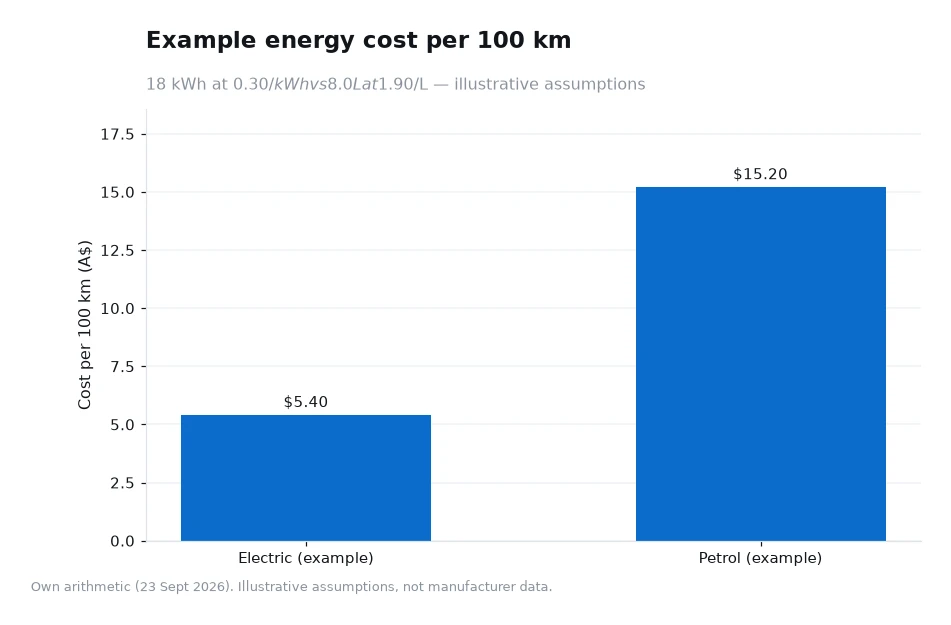
Test drives should end with arithmetic, not a feeling. This example uses illustrative assumptions rather than manufacturer data. Assume an electric car using 18 kWh per 100 km and home electricity at $0.30 per kWh: 18 multiplied by 0.30 gives $5.40 per 100 km. Assume the petrol SUV it replaces uses 8.0 L per 100 km at $1.90 per litre: 8.0 multiplied by 1.90 gives $15.20 per 100 km. The gap is 15.20 minus 5.40, or $9.80 per 100 km.
Scale it to a year of driving. At an assumed 15,000 km, that is 150 blocks of 100 km, so the electric figure becomes 150 multiplied by 5.40, or $810, and the petrol figure becomes 150 multiplied by 15.20, or $2,280. The annual difference is 2,280 minus 810, which is $1,470. Change the assumptions and the answer moves, so substitute your own electricity tariff and your own fuel price before you use any of it in a household budget.
Frequently asked questions
What should I bring to an EV test drive?
Bring your own route notes, the build you configured online, any child seats or prams you use weekly and a charged phone with the brand's app installed. The route matters most, because a familiar car park and highway ramp reveal more than a dealer loop.
Do I need to charge the car during the test drive?
It is worth doing once if a public charger is nearby. A single stop shows you how the flap opens, how heavy the cable feels and how quickly the state of charge climbs between 10% and 80%.
Book the drive with a plan in hand
Ask for a longer slot than you think you need and tell the dealer in advance that you want to check charging, boot space and the assistance systems. If you would rather read every figure at your own pace first, the electric suv australia model pages publish the ranges, charging windows and warranty terms in full. Take the XPENG X9 comparison seriously as well: if the seats you need are seven rather than five, drive both on the same day so the difference is fresh in your memory.
Afterwards, put the ten answers in a table of your own with the warranty term beside each, and ask for the formal quote plus a copy of the service and warranty wording you were quoted from. Decisions made with the documents in front of you are the ones that survive the first service visit.
Specifications, warranty terms and service intervals above are taken from the manufacturer's Australian site, read 23 Sept 2026; WLTP range depends on conditions, Nappa leather availability varies by configuration, and XPILOT ASSIST is an assistance function where the driver stays responsible. The cost figures are illustrative assumptions, not manufacturer data.[1]