Inside a Brewing House: Vessel by Vessel
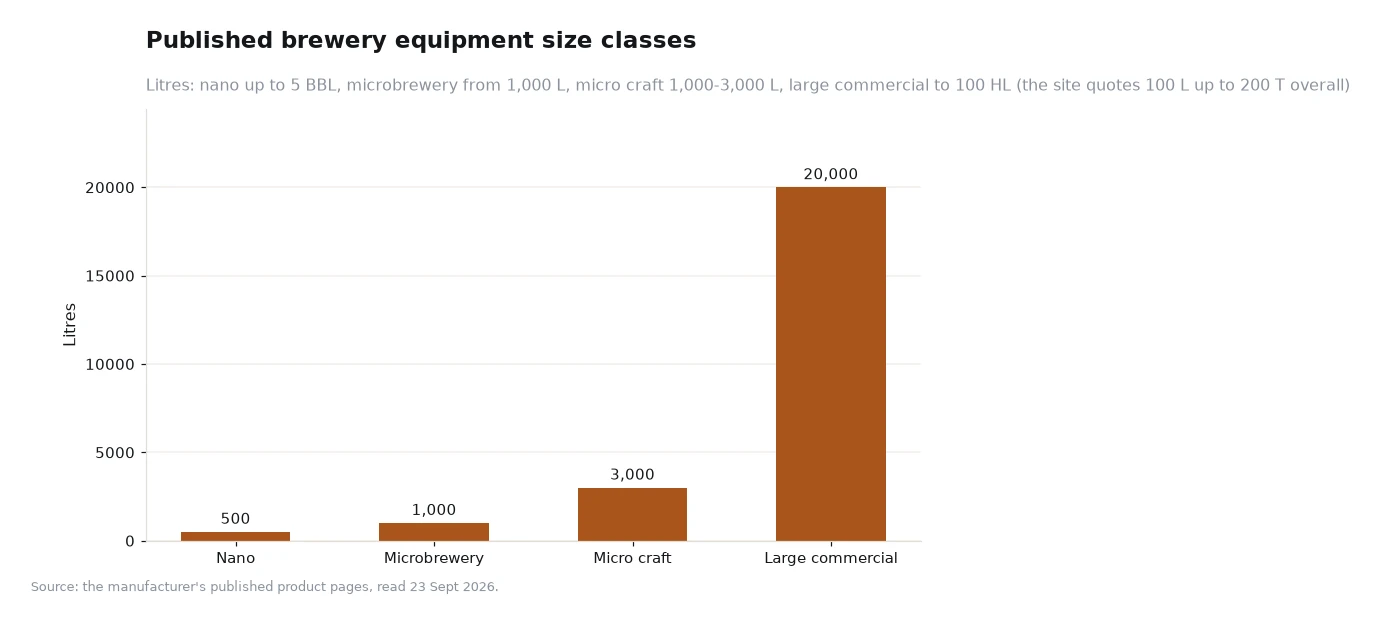
A brewing house is a sequence of jobs rather than a row of tanks, and the number of vessels decides how much of that sequence can happen at the same time. Hermann publishes hot-side builds in two, three and four-vessel form from 500 litres up to 2,500 litres, alongside the fermentation, filtration, CIP and control equipment that finishes the job. The Brewhouse listings show which jobs share one vessel and which ones get their own, and that is the detail that changes both your brewing day and your labour bill.
Key takeaways
- From 500 litres upward the published ladder offers a three-vessel set, which separates the job that a two-vessel kit combines in one tank.
- A four-vessel line from 2,000 litres gives mash, lauter, kettle and whirlpool their own vessels, so the next step starts while the last one finishes.
- Boil and whirlpool always work in sequence — the whirlpool is where trub settles after the boil, not during it.
- Every vessel carries a data plate with its pressure-testing record and serial number, and each shipment leaves with five inspection steps behind it.
Why the vessel count changes the whole day
The hot side is a chain: mash, lauter, boil, whirlpool, cool. In a two-vessel build the chain runs end to end inside two tanks, so one batch must finish before the next can begin. Adding a third vessel breaks one link out of that chain, and adding a fourth breaks another, which is why vessel count is the first question in any capacity discussion and kettle size is the second. The published ladder reflects that logic rather than fashion: 500 litres in three-vessel form, 1,000 litres in two, three or four-vessel form, a 2,000 litre build in two-vessel copper or three-vessel form, and a 2,500 litre four-vessel set.
| Published build | Vessels | What the vessel count changes |
|---|---|---|
| 500 L three-vessel | Three | One hot-side job leaves the shared tank, so brews can overlap instead of queueing. |
| 1,000 L | Two, three or four | The widest choice on the ladder; this is where the sequencing decision is actually made. |
| 2,000 L | Two (copper option) or three | Bigger batch per brew, with lautering and boiling still sharing a vessel in the two-vessel version. |
| 2,500 L four-vessel | Four | Mash, lauter, kettle and whirlpool each get a vessel, so the next batch starts earlier in the shift. |
Mash and lauter: conversion first, then separation
Mashing holds crushed malt in hot water long enough for enzymes to convert starch into sugar; lautering then separates that sweet liquid from the spent grain and rinses it with sparge water. The two jobs need different things from a vessel — one wants even heat and slow agitation, the other wants a false bottom and a gentle flow — which is exactly why a set that gives them their own tanks costs more but runs faster. Where they share a vessel, the brewer waits for the grain bed to settle before running off, and every batch carries that wait. Ask whether a lautering device is part of the drawing before you compare two quotes, because a shared tank without one is a different brewing day from a shared tank with one.
The kettle: boil strength, steam and hops
The kettle boils wort for roughly an hour, sterilising it, driving off unwanted volatiles and isomerising hop acids into bitterness. Boil strength matters more than most first-time buyers expect: a rolling boil needs steam or heating capacity that matches the volume, and it needs a jacket or coil that keeps up rather than chasing the setpoint. This is also where hop additions land, so kettle design affects both bitterness and the amount of trub you will later have to separate. When a proposal lists a kettle, ask for the heating method in writing — steam, direct fire or electric — because the answer changes the boiler, the flue and the electrical supply on your site, not only the vessel.
Whirlpool and hot liquor: the two ends of the hot side
After the boil the wort is pumped into a whirlpool, where it is stirred into a slow rotation so solids — hop debris, protein and trub — gather in a cone at the centre and the clear wort can be drawn off the side. Skipping or hurrying this step sends coarse material into the fermenter, where it carries over into flavour and into the yield you lose at the bottom of the tank. At the other end of the hot side sits the hot liquor tank. It feeds mashing, sparging and cleaning, often on the same morning, so its size follows the day's water use rather than a single batch. Both vessels are ordinary tanks with specific internals, and both are easier to specify at the drawing stage than to retrofit into a working brewery.
Worked example: a three-vessel day against a two-vessel day
The arithmetic below is an example with every assumption stated, using a 1,000 litre batch, an eight-hour brewing shift, and these step times: mash 60 minutes, lauter 90 minutes, boil 60 minutes, whirlpool 30 minutes. In a two-vessel kit the four steps run one after another, so one brew takes 60 + 90 + 60 + 30 = 240 minutes; an eight-hour shift (480 minutes) therefore finishes two brews, because 240 x 2 = 480. In a three-vessel kit the lautering step gets its own tank, so from the second brew onward lautering overlaps the previous boil and the marginal brew takes 150 minutes: 240 + 150 + 150 = 540 minutes, or three brews in a nine-hour day. Over a five-day brewing week that is 15 brews instead of 10, which at 1,000 litres each and a 2% transfer loss is 14,700 litres against 9,800 litres of packaged beer. Same brewhouse footprint, roughly half again the output — provided you have fermentation vessels and a market for it.
Frequently asked questions
What is the difference between a two and three-vessel brewing house?
A two-vessel set combines mash with lautering in one tank and boiling with whirlpooling in the other, so brews run one after another; a three-vessel set separates one of those pairs so the next step can begin while the previous one finishes.
How much hot liquor storage does a brewing house need?
Plan for a hot water tank of roughly 1.5 to 2 times the batch volume, an assumption rather than a published figure, because mashing, sparging and cleaning all draw from it on the same day.
What to settle before the design meeting
Bring four numbers to the first call: batch size, brews per day, the beer styles you intend to brew most often, and the utility supply you actually have — steam, electricity or gas, plus floor drain positions. Those answers decide the vessel count far more reliably than a general wish for flexibility, and they let a technical team draw a layout you can cost rather than a catalogue page you cannot. Hermann has 23 years of craft brewing design behind its hot-side builds and sells into more than seventy countries, so a short brief usually produces a proposal that fits the space instead of one that has to be trimmed afterwards. Ask to see the equipment list on the brewery equipment side of the catalogue as well, since what arrives after the hot side is where most of the plumbing decisions are made. A short conversation with the technical team before drawings start costs nothing and usually saves a revision.
Vessel sizes, inspection steps and tank data plates described above come from the manufacturer's own website at hembrewing.com, read on 23 Sept 2026; the shift arithmetic is our own example and assumes the step times listed in the text. Check the current hot-side builds before you fix a layout[1].