The catalogue tells you what a private label perfume factory has made before; the first conversation tells you what it can make for you. Factories that answer scope questions precisely, state their limits, and stay consistent when the questions get specific are usually the ones a project can be built on. The interview script below is short on purpose, because the value is in the follow-ups rather than the checklist.
Key takeaways
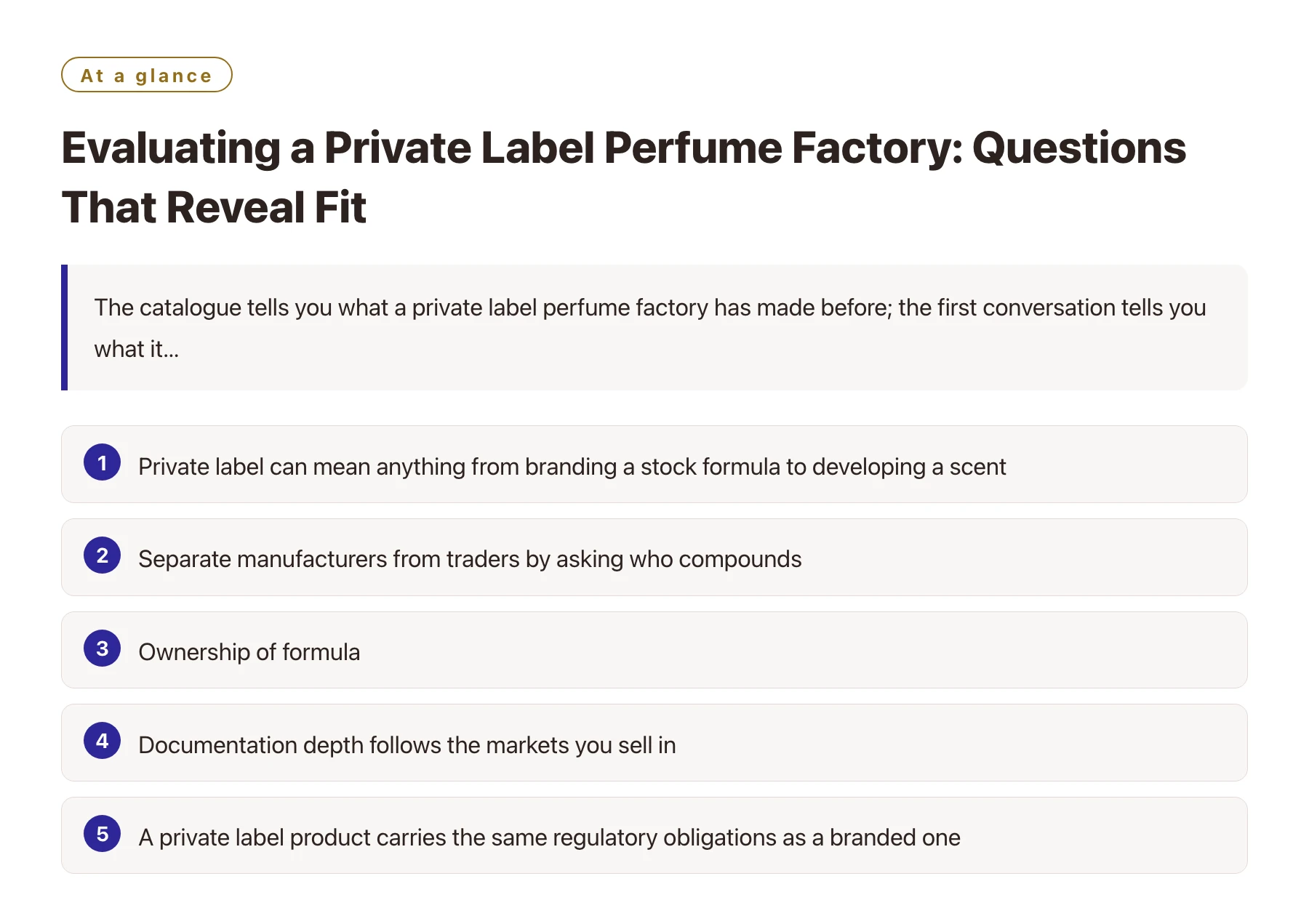
- Private label can mean anything from branding a stock formula to developing a scent, so the first question is which services are actually in scope.
- Separate manufacturers from traders by asking who compounds, who fills and who holds the technical documentation for the product.
- Ownership of formula, mould and artwork decides your options later, and it should be settled in writing before a first order.
- Documentation depth follows the markets you sell in, so a supplier who asks where the product is going is usually the more useful partner.
- A private label product carries the same regulatory obligations as a branded one, including the responsible person requirement in the European Union.
Every factory profile looks similar from the outside: a capability list, a handful of processes, a set of certificates. The differences that matter to a brand show up in conversation, especially when the questions move past what the supplier does and into how the work is divided.
This guide sets out what the first conversation should establish, the topics where answers separate serious suppliers from hopeful ones, and how to decide with imperfect information.
What the first conversation should establish
Before discussing price or samples, three things need to be clear: which services the supplier performs itself, which it coordinates, and what the brand will own at the end of the project.
Those three answers shape everything else, including how much the project costs and how easy it is to move later.
Private label means several different things
In practice the term covers a spectrum. At one end, a brand applies its label to a stock formula and an existing pack. In the middle, the scent is adapted and the packaging is chosen from a catalogue. At the other end, the formula and the pack are developed specifically for the brand.
Each option has a different cost structure and a different level of exclusivity, so an early question is which of the three the supplier is actually proposing.
Who does the work is a real question
Some suppliers compound and fill in their own plant; others coordinate a network of partners. Both models can deliver a good product, but they behave differently when something goes wrong, because a coordinating supplier has to negotiate a fix rather than make one.
Ask which steps happen on site: compounding, filling, packing, testing. The answer tells you where the supplier has direct control and where it depends on someone else's schedule.
Regulation does not care whose name is on the bottle
A private label product carries the same obligations as a branded one. In the European Union, cosmetics placed on the market require a responsible person and a product information file, and that requirement applies regardless of who developed the formula [3].
For a first-time brand, this is often the most underestimated part of the project, which is why the supplier's appetite for documentation questions is revealing.
Answers that separate a serious factory from a hopeful one
| Topic | Thin answer | Specific answer | Why it matters |
|---|---|---|---|
| Scope of service | We do everything | Compounding and filling on site; bottles sourced from named partners | You learn where your schedule depends on a third party |
| Formula ownership | It stays with us, as usual | Exclusive or non-exclusive, defined in the contract | It decides whether a competitor can buy the same scent |
| Minimum order and tooling | Low minimum, we will work it out | A stated first-order quantity with tooling quoted separately | You can calculate the real entry cost before committing |
| Documentation | All certificates available | A named set of documents for the markets you named | Market access depends on paperwork, not on capability |
| Batch approval | We check everything | Retained reference sample plus a release step you can see | Consistency across reorders is what customers notice |
The pattern in the second column is worth noticing: thin answers are not lies, they are shortcuts. A supplier who can move from the second column to the third when asked is showing that it knows its own process. One topic deserves a second question, not just an answer: who performs the testing, since independent laboratories such as SGS test cosmetics and personal care products against GMP and conformity requirements on behalf of brands [1].
A short interview script
- Ask what happens on siteName each step, from compounding to packing, and have the supplier say which ones its own team performs.
- Ask who owns whatFormula, mould, artwork and print plates. Ownership determines what you can take with you later.
- Ask for a redacted batch recordOne example shows the checks, the recorded values and the sign-off better than any description.
- Ask what documentation covers your marketsName the countries you plan to sell in and ask which documents the supplier can provide for each.
- Ask about a change after approvalWhat a different closure or an extra label round costs reveals how the supplier handles scope changes.
- Ask for two references you can questionA brand that has reordered is more informative than a brand that placed one order and moved on.
Deciding with imperfect information
No amount of interviewing removes the uncertainty from a first order. What it can do is make the uncertainty visible, so the risk is a known quantity rather than an unpleasant surprise.
Watch for consistency, not polish
A supplier that gives the same answer to the same question twice, in two different conversations, is showing that its process is documented rather than improvised. After three or four conversations, a workable picture of what a good private label perfume factory looks like begins to form: not a flawless supplier, but one whose limits are known.
Match the supplier to the project, not to the pitch
A factory set up for large fragrance programmes may be a poor fit for a small body-care range, and a small flexible plant may struggle with a complex multi-item launch. Fit is about the shape of the project as much as the size of the company.
Decide the non-negotiables first
Write down the three things the project cannot lose, whether that is market compliance, a delivery window or a unit cost ceiling. Suppliers who can meet all three are shortlisted; the rest are conversations for a later project.
If material safety is one of the three, ask how the supplier tracks the restrictions that industry bodies such as the International Fragrance Association maintain for fragrance materials [2]. A supplier who can describe that process is likely to handle a reformulation request without drama.
Most private label disappointments trace back to a scope that was never written down. The brand assumed filling was included, the supplier assumed the packaging was the brand's responsibility, and the assumption surfaced a week before shipping. Before any deposit, put six lines in writing: the exact services in scope, the order quantity, who owns the formula and tooling, the documentation to be supplied and for which markets, the approval process including a retained reference sample, and what a change after approval costs. None of those lines is difficult to agree. Each of them is expensive to discover later.
Sources
- SGS: Cosmetics, Personal Care & Household Testing —— Testing, inspection and certification services for cosmetics and personal care, including microbiological, stability and safety testing aligned with cosmetics GMP.
- International Fragrance Association (IFRA) —— IFRA is the global trade association of the fragrance industry; its site publishes the IFRA Standards, positions and science on the safe use of fragrance materials.
- European Commission: Cosmetics in the EU —— The European Commission's overview of EU cosmetics rules, including the responsible person, product information file and safety report requirements.
Frequently asked questions
What is the difference between private label, white label and OEM perfume?
The terms overlap and suppliers use them loosely. White label usually means a ready-made formula with your branding, private label can include an adapted scent and packaging, and OEM generally means the product is manufactured to your specification. What matters is not the label but which services are in scope.
Should a small brand use a private label factory or a fragrance house?
It depends on whether the constraint is creative or operational. A fragrance house is built around developing scents, while a private label factory is built around producing and packing a finished product. Many small brands start with a factory that offers both, then move to a dedicated fragrance brief as the line grows.
How do I know whether a supplier is a manufacturer or a trader?
Ask which steps are performed on site and request a redacted batch record covering compounding, filling and release. Factories can answer those questions with process detail, while traders tend to answer with capability statements and price lists.
Who should own the formula in a private label arrangement?
It depends on what you paid for and what exclusivity you need. If the formula was developed specifically for your brand, exclusive ownership is reasonable to negotiate. If you selected a stock formula, the supplier will usually keep it and license its use. Either way, the answer belongs in the contract.
What documents should come with a private label fragrance order?
At minimum a specification, a certificate of analysis for the batch, and the safety and labelling documentation required by the markets you named. Some destinations add notification or responsible-person obligations, so the document list should be agreed before the first order rather than requested after it ships.