CrushOn.AI vs General-Purpose Chatbots: Where the Differences Show
The difference between an adult character platform and a general-purpose assistant is not the text model underneath but what the product is built to do with it. Crushon is organised around named characters with tags and creator credits, a Memories area for continuing conversations and filter chips that include an Unfiltered mode; a general assistant is organised around tasks, with a policy layer that shapes what it will engage with at all. Usage patterns show the split: 16 sessions a month at 30 minutes each is 8 hours, which is a very different budget from asking a question and closing the tab.
Key takeaways
- Persona is the organising principle here: profiles carry tags, a description and a creator credit, and each one is a distinct character rather than a single assistant voice.
- Continuity is a product feature, not an accident: continuing conversations live in a Memories area beside the character list, which is the reason a second session can pick up where the first ended.
- Filters are visible settings — Unfiltered, Filtered and 18+ — and the site states that some limitations still apply under its content and community guidelines.
- Budget by hours, not by messages: 4 sessions a week for 4 weeks is 16 sessions, which is 8 hours a month at 30 minutes each.
Persona first, or task first
Ask a general-purpose assistant for help with a spreadsheet and it becomes a competent collaborator with no fixed identity. That is the right design for a tool, and it is exactly what a character platform does not want. Here, the unit is a profile: a named character with a description, tags and a by-line, ranked on a public chart and browsed by category. Reading twenty cards gives you twenty distinct voices, which is a form of variety a single assistant cannot offer by design.
The practical effect shows up in how sessions begin. On a tool, you arrive with a question. On a character platform, you arrive with an intention — to continue a thread, to start a scenario, or to browse for something new. That difference in the opening move changes everything downstream, from how long a session lasts to what makes it feel finished.
Where memory differs
A general assistant's memory is usually about the task: it tracks what you asked and what you want, and the thread ends when the task does. Continuity in a character platform is the point rather than a side effect. The platform describes its characters as recalling previous interactions, expressing emotion and adapting over time, and it separates ongoing conversations from the character list so that threads can carry state between sessions.
The two behaviours are not competing, they are answering different needs. Task memory is about accuracy across a project; persona memory is what makes a second session feel like a continuation. If you are comparing the two categories, that is the line to check on: not how long the context window is, but whether the product treats a conversation as something worth carrying forward.
Filters, guidelines and what each implies
An adult platform states its audience up front. The site carries an 18+ framing, a compliance statement describing its content as AI-generated text depicting no real person, and filter chips labelled Unfiltered, Filtered and 18+. A general assistant usually arrives with a broad audience and a policy layer built for one, so its behaviour is shaped by what must not be discussed rather than by which mode you have selected.
The distinction worth holding on to is that Unfiltered is a browsing mode, not the absence of rules. The platform's own FAQ notes that some limitations apply under its content and community guidelines, and each content page carries a report route. A reader who understands that will use both categories more accurately.
| Dimension | Adult character platform | General-purpose assistant |
|---|---|---|
| Unit of use | A named character profile with tags and a creator credit | A session with no fixed identity |
| Organising idea | Persona, discovery and continuity | Task completion and accuracy |
| Memory | Continuing conversations kept separately from the character list | Context carried for the duration of the task |
| Filters | Unfiltered, Filtered and 18+ settings, plus a gender filter | A single policy layer applied to all users |
| Discovery | Weekly chart, tag-based search, sections such as Recent Hits and Animated | No library to browse; you supply the prompt |
| Session length | Typically tens of minutes, repeated across a week | Usually short and tied to a specific question |
Worked example: two very different hourly budgets
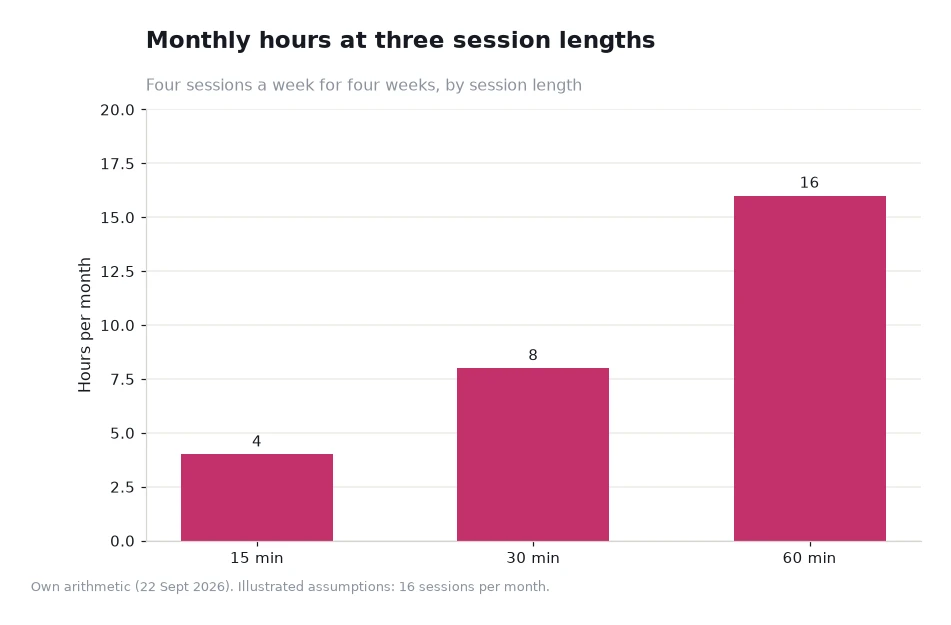
Take the character-platform pattern first: four sessions a week for four weeks. That is 16 sessions a month, and the chart beside this section converts them into hours. At 15 minutes a session, 16 × 15 = 240 minutes, or 4.0 hours a month. At 30 minutes, 16 × 30 = 480 minutes, or 8.0 hours. At 60 minutes, 16 × 60 = 960 minutes, or 16.0 hours. Those are illustrative assumptions, not platform data.
Now take a task-shaped pattern: five questions a week at about five minutes each. That is 25 minutes a week, or roughly 100 minutes a month — about 1.7 hours. Set against the 8-hour pattern, the character platform is using nearly five times the time, and against the 16-hour pattern almost ten times. The figures are illustrative, but the shape is the useful part: a tool is consumed in short bursts, while a character platform substitutes for an evening's activity rather than a lookup.
That comparison also suggests how to choose. If you want an answer, a general assistant is the better instrument. If you want something to return to on repeated evenings, the persona, the chart and the continuing-conversation area are the features that matter, and they are the ones the general category is not designed to provide.
Seeing the difference from the front page
The clearest way to test any of this is to open https://crushon.ai/ and look at what the page offers. Navigation split across Characters, Memories and Creators; a filter bar rather than a prompt box; section shelves such as Recent Hits and Animated. A general assistant's landing page asks you what you want to know. This one asks you who you want to talk to, and the difference in framing is the whole comparison in one screen.
For a second opinion, the platform's own description of its features and FAQ explains the intended use directly, and the weekly chart is the fastest way to see the library as a reader does rather than as a feature list. Two minutes on each is enough to decide which category fits the evening you have in mind.
Frequently asked questions
Is an adult character platform just a chatbot with different rules?
No. The rules are part of it, but the larger difference is architectural: profiles with tags and credits, a public chart, and a separate area for continuing conversations. A general assistant has none of those because it is not built to have a library.
Which one remembers more?
They remember different things. A general assistant tracks the task in front of it, while a character platform keeps continuing conversations so that a second session can carry on from the first. Comparing raw context sizes misses the design difference.
Do the filters mean anything is allowed?
No. Unfiltered is a browsing mode and the platform states that some limitations apply under its content and community guidelines. The filters change what you see, not what the platform permits.
Choose by the evening, not the label
Decide what you want before opening either category. If there is a question to answer, use a tool and keep it short. If there is a story to continue, go where the profiles, the chart and the conversation history live, and budget an hour rather than five minutes. Knowing which of the two you are doing is most of the comparison; the rest is interface detail.
Data and sources: the navigation, sections and filter options shown on the platform's home page[1] and its published product description[2], read 22 Sept 2026. Session-length and task-pattern figures are illustrative assumptions. Intended for adult readers 18+.